
After ten years obsessed with government auctions, I built the price-guide and bid assistant that didn't exist
A pallet of iPhones draws 248 bidders; a $250,000 school sells with just one. What I found, and what I learned building GovAuctions.app, after a decade lurking the weirdest corner of American commerce.
Live government auctions right now
Browse all →


Right now the US government is selling a twenty-two-storey courthouse in Miami. Also the Zamboni from New York's Wollman Rink, a 2025 Escalade seized by the US Marshals, a pile of gold coins from safe deposit boxes nobody came back for, and a two-bedroom house in East Saint Louis listed at $5,000. It's all legal, it's all public, but hardly anyone is bidding. The courthouse has been on the market since June without a single bid.
I've been obsessed with this stuff for about ten years. It started when I realized you could buy seized luxury goods, precious metals and seized sports cars straight from the government. The market is wildly inefficient, though; a used iPhone goes for near retail on one platform and a quarter of that on a county surplus site three states away. A used Husqvarna riding mower goes for $10 to the one person who bothered to click. Across 242,314 completed sales in the last year, 31% of lots got zero bids at all. The whole market is cheaper than people assume: across the 158,554 completed sales in the price index since May 2026, the median government lot sold for $300.
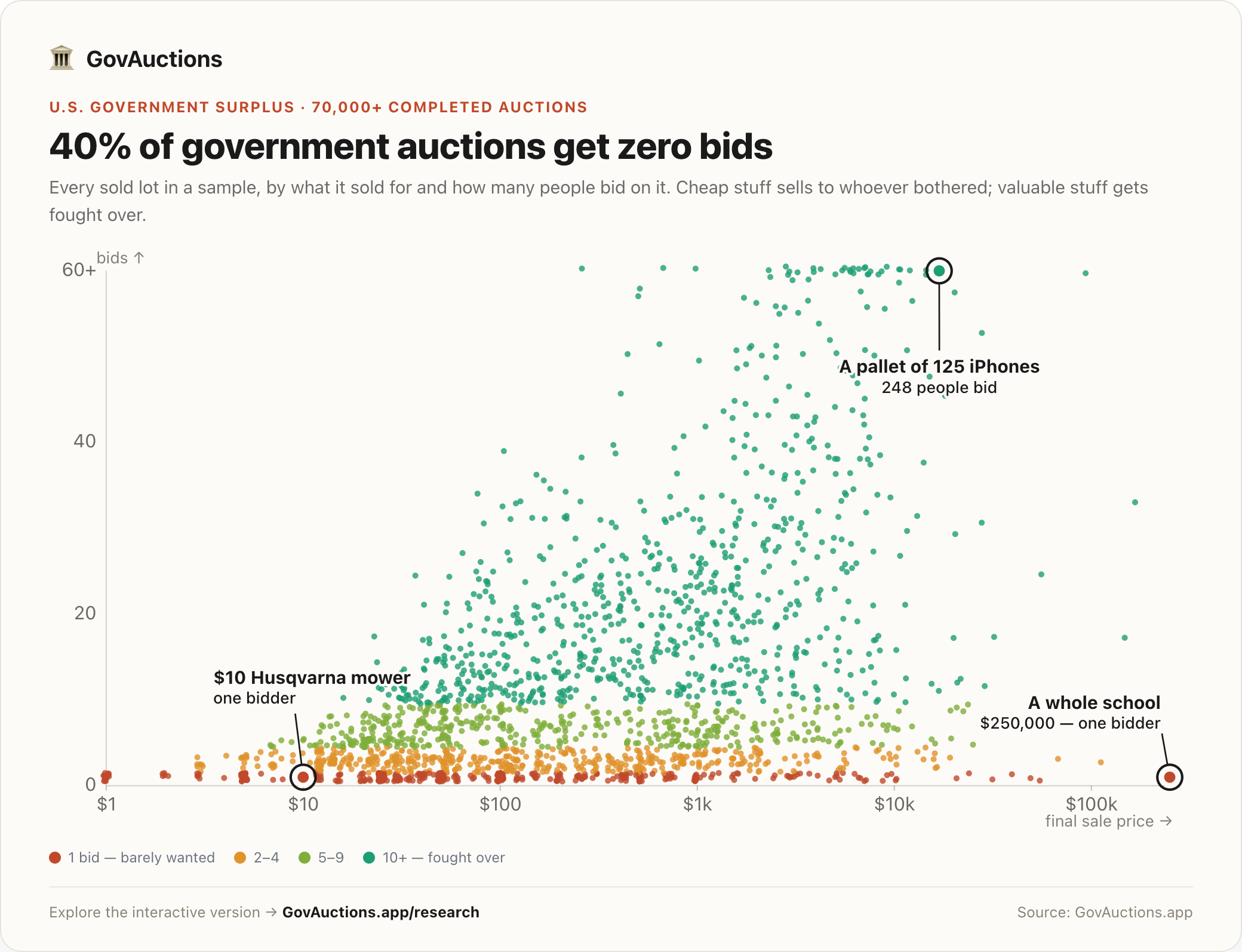
There is no big secret, it's just the government has more of an incentive to get rid of the stuff than make a profit, and low visibility plus the hassle of pickup and transportation mean that the price rarely gets bid up to what the thing is actually worth.
Today, GovAuctions.app tracks 63,000+ live listings across 52 platforms and eight countries, refreshed twice a day. What professional resellers care most about, though, is conspicuously absent from the main platforms: is a given listing a good deal at the current price. Most of the platforms aren't incentivized to provide this information, because their revenue is directly tied to the final bid price.
So I started archiving final prices, 310,000+ completed sales now, and used them to grade live lots: a 0 to 100 Flip Score backed by real comparable sales. Basically a Kelley Blue Book for government surplus, which as far as I can tell never existed before.
There were a few parts that turned out to be genuinely difficult to build, but by far the hardest were search quality (de-duping similar items, de-ranking lots with significant damage or issues), and then ranking and pricing each item reliably. Those are still the things I spend most time on today.
Valuing a used pickup is relatively easy - there are thousands of comparable sales and everyone agrees what a truck is. But what about a truck that needs coolant repair, or one with an engine leak, or one where no damage is listed, but it looks dinged up on the photo? Then there are decommissioned hospitals, or pallets of random unlabeled office gear, or a single lot of mixed jewelry, or gold coins where the melt value is a floor but the collector premium frequently fluctuates.
Each category breaks the ranking in a different way, and a deal score that's confidently wrong is worse than not having one at all.
The strange geography of who bothers
The data that comes out of all this is surprising and often counterintuitive, so I've started writing some of it up. One thing I didn't expect: bidding isn't spread evenly across the country. When I mapped 58,909 auctions by how hard each lot got bid on, the competition clustered in small towns across the Plains, the upper Midwest and the South.
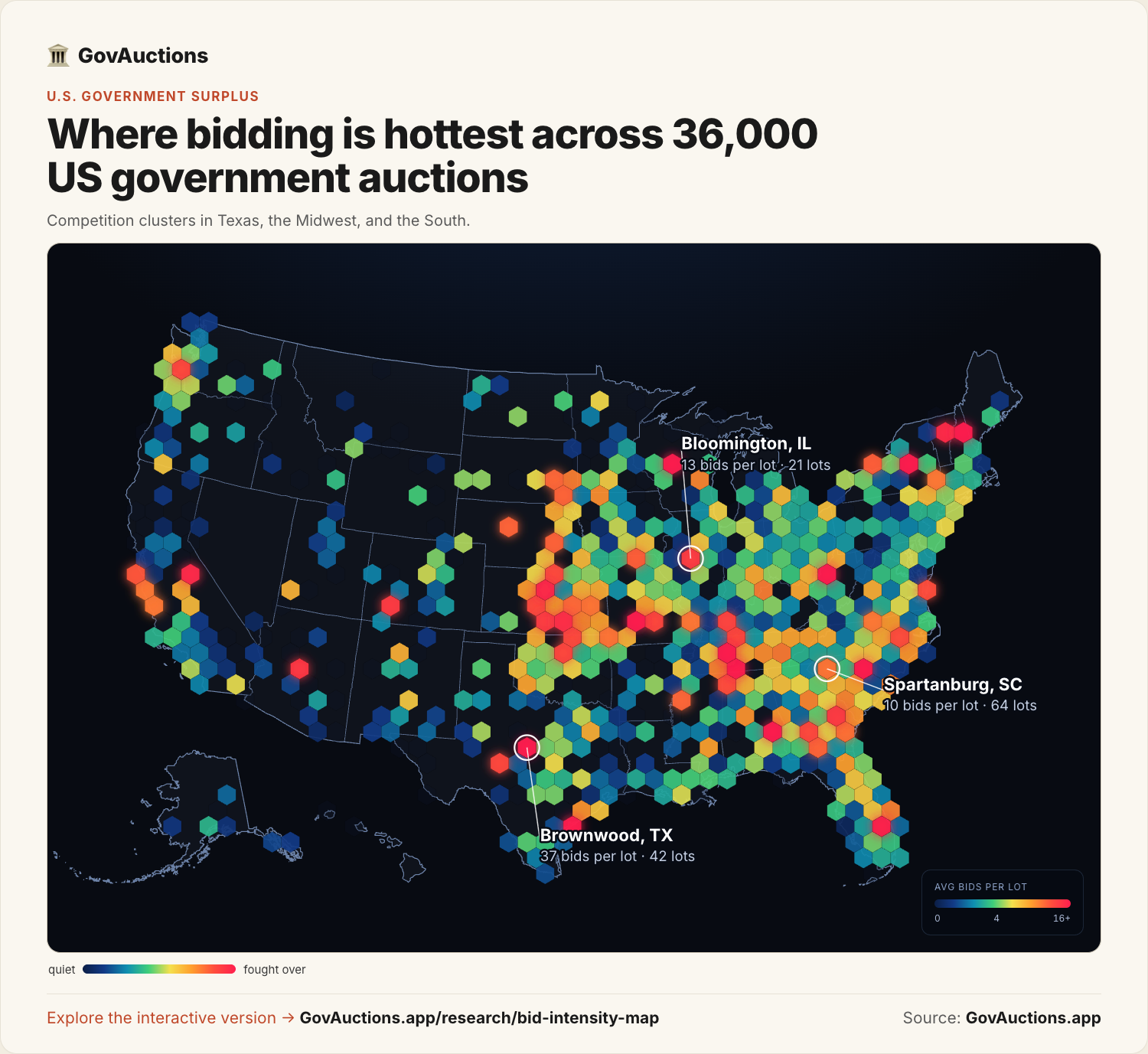
The map is live and the leaderboard rotates faster than I expected. In late August the hottest cells were Thibodaux, Louisiana, Gray, Georgia and Vinita, Oklahoma; by the end of September it was Covington, Georgia at 27.6 bids per lot, Arden Hills, Minnesota at 21.0 and Seminole, Oklahoma at 20.7. At state level it's steadier, South Dakota at 8.1 bids a lot, Minnesota 6.9 and Oklahoma 6.6 against California at 0.8. These are small and mid-size markets where enough people have quietly learned the game that they now compete against each other, while a similar lot in a big coastal metro often draws a shrug. I also mapped where you can buy the cheapest houses in America, which turned into one of the most-read things I've published.
The number that went down
The most useful thing publishing this data has taught me is to let the numbers move. When I first wrote this, I said about 40% of government lots get zero bids. That came from a much smaller sample. The figure is now recomputed from the whole archive every time the data refreshes, and across 242,314 completed auctions it has settled at 31%. Still a third of everything the government lists, but not two in five.
I also wanted to be sure the zero-bid lots were real and not an artifact of snapshotting auctions before the last-minute bids arrive. So we went back and pulled the true closing bid for more than 4,500 recently ended GovDeals lots. 99.7% of the ones we had recorded as zero-bid never got a competitive bid. The lots nobody wants really are wanted by nobody.
The same instinct is behind the price index now publishing a frozen monthly release. The live numbers change daily, which is right for a buyer and wrong for anyone who wants to quote us, so each month is locked as a citable release that never changes. The first, US-2026-09, covers 135,590 completed lots.
The bidding still happens on the government platforms, and GovAuctions.app is the intelligence layer that tells you what something's worth before you bid.
Anyway, that's the thing I spent ten years wanting to exist and finally built. Always interested in hearing from anyone who's built something in a similarly messy domain, and especially if you've bought something genuinely weird from the government. What did you end up with?
You can dig into the numbers in the government surplus research hub, or browse live government auctions to see what's on the block right now.
Ready to find deals?
Search every government surplus auction at once - free.
Browse All AuctionsWant to know where this data comes from? See every auction source we track.