
Want to buy a military plane, some gold coins and a $5,000 house? Welcome to the strange world of Government Auctions
A pallet of iPhones draws 248 bidders; a $250,000 school sells with just one bid. Inside the government surplus auction market, where the biggest edge is knowing where to look.
Live government auctions right now
Browse all →


Somewhere in America right now, in this time of sky-high mortgage rates and inflation, the government is selling a house for $5,000.
It's a two-bedroom, one-bath house in East Saint Louis, Illinois, built in 1925, that HUD took back in foreclosure and is selling as-is. And it's not alone. Of the 2,408 government-owned homes listed right now, 336 are under $100,000 across 38 states, 78 are under $50,000, and 22 are under $25,000. You can buy a house from the government for the price of a used car, and most people have no idea.
The government also sells seized gold coins and jewelry, decommissioned aircraft, police cruisers by the fleet, forklifts, ambulances, industrial kitchens from closed prisons, and in 2026, an entire school building for $250,000.
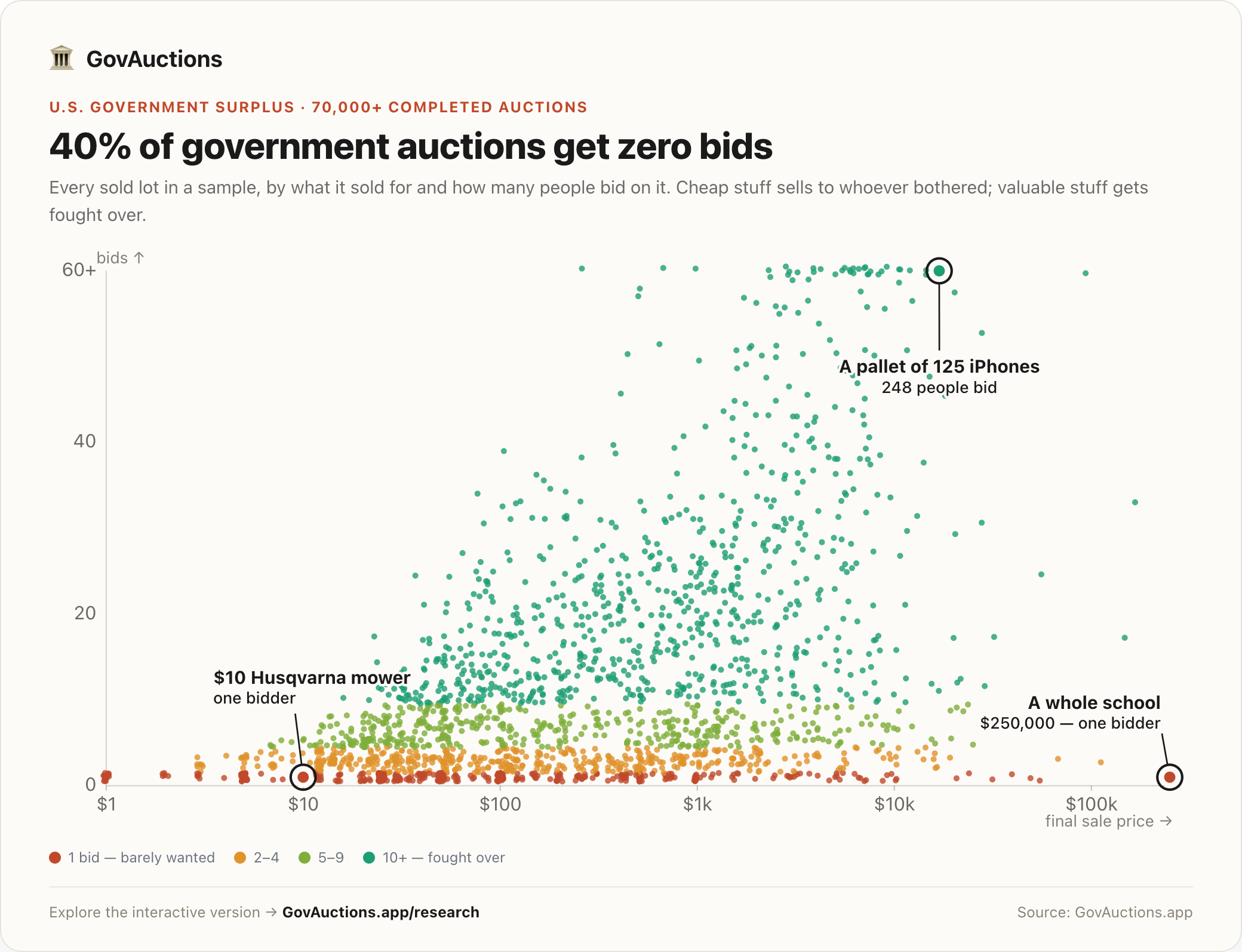
Despite the huge volume of bargain vehicles, electronics and real-estate, 31% of lots get zero bids - nobody shows up at all. That is across 242,314 completed U.S. auctions in the last twelve months, on the platforms that report a trustworthy bid count.
Government surplus auctions are one of the last corners of American commerce where an ordinary person can routinely buy something for less than it is worth, because the competition just isn't there.
A gap that pays the rent
Every county, police department, school district, and federal agency accumulates stuff it eventually has to sell. By law most of it goes to public auction. In practice, those auctions are scattered across hundreds of obscure agency websites that almost nobody checks.
Anything with an obvious resale market - iPhones, popular truck models, brand-name tools - gets found and fought over. A pallet of 125 iPhones in our data drew 248 bidders. Everything else clears for a fraction of its value, or does not sell at all. A used Husqvarna riding mower went for $10, to the one person who bothered to click.
The people who do this for a living work that second bucket. They buy the $10 mower, replace a belt, and list it for $400. They buy the pallet nobody noticed. It is a quiet but real corner of the side-hustle economy: the resale world already runs on eBay and Facebook Marketplace, and government surplus is the underexploited supply feeding into it. The barrier is knowing where the auctions are.
What the whole market actually clears for
Because we archive final prices, the market has a number. Across the 158,554 completed U.S. auctions in our surplus price index since May 2026, the median lot sold for $300. Not $300 off retail. $300, full stop. That is what the middle of the government's castoff is worth on the day it closes.
Underneath that median the spread is enormous. Vehicles, the biggest category by volume with 56,608 sales, run a median of $2,500 a lot, and heavy equipment $1,650. Furniture runs a median of $14. We don't publish category price movements, because two monthly medians describe two different baskets of stuff, not one price going up or down.
Prices are only half of it. The market report shows vehicles clear most reliably at 89% sell-through, with heavy equipment just behind at 88% - and both are the most contested, with vehicles drawing a median of 20 bids. At the other end, art and decor lots typically close with a single bid. The pattern holds everywhere in this market: the more obvious the resale value, the more people you have to beat.
Where the competition actually is
Bidding is not spread evenly. When we mapped 58,909 US government auctions by how many bids each lot drew, the heat concentrated in small towns across the Plains, the upper Midwest and the South.
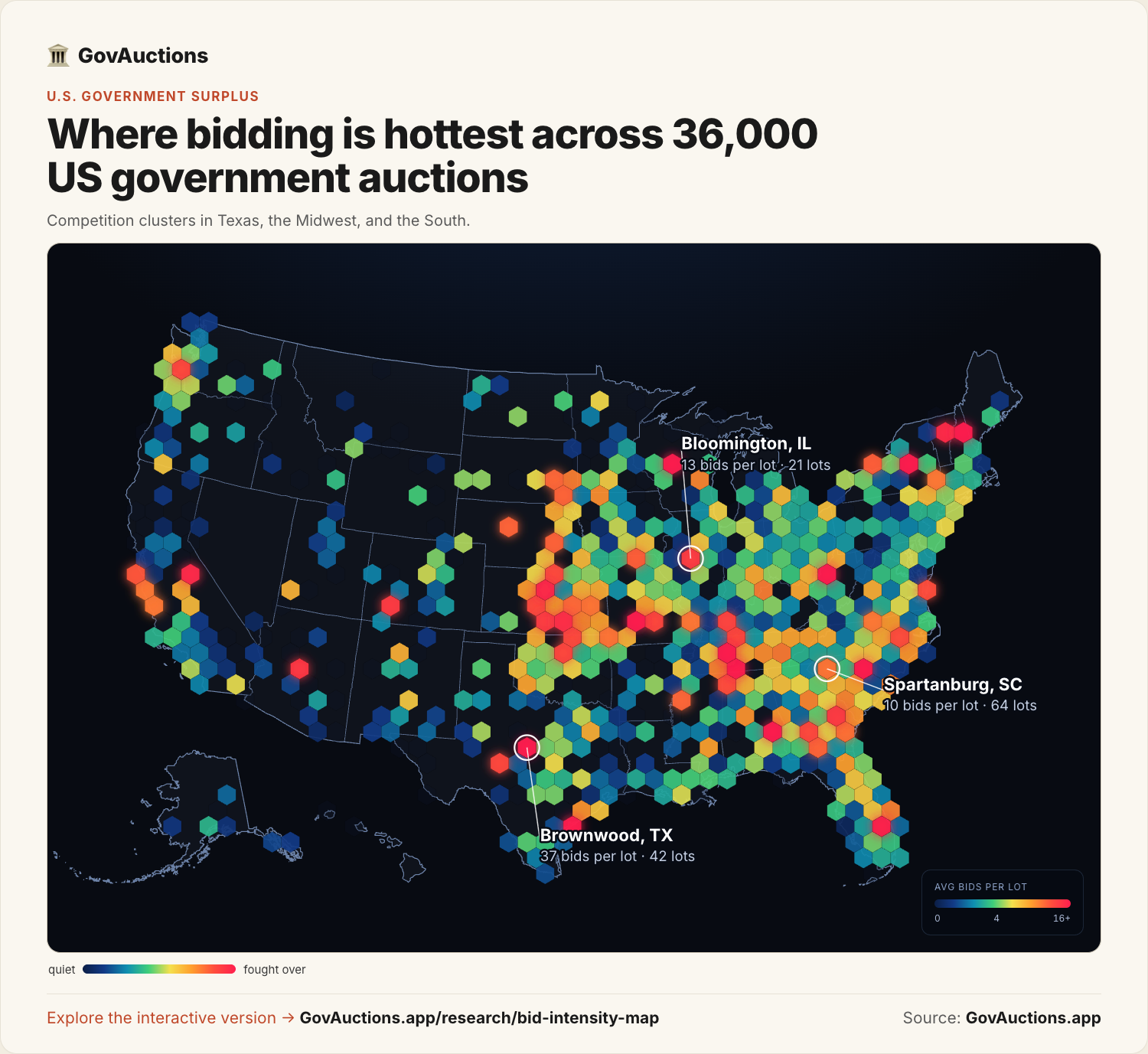
The map is live, so the hottest towns rotate, and fast. In late August 2026 the leaders were Thibodaux, Louisiana, Gray, Georgia and Vinita, Oklahoma. A month later, on September 28, none of them made the top of the list: it was Covington, Georgia at 27.6 bids per lot, Arden Hills, Minnesota at 21.0, and Seminole, Oklahoma at 20.7. The state ranking moves more slowly, but it moves too. South Dakota now leads at 8.1 bids per lot, followed by Minnesota at 6.9 and Oklahoma at 6.6, while Kansas, top in August, has slipped to 6.0. California sits at 0.8, and Texas, despite having more mapped lots than almost anywhere, averages just 1.8.
These regions churn out exactly the lots that resell well close to home - county and school-district fleet trucks, farm and shop equipment, work vehicles - and they have deep benches of local resellers who already know to check. In the big coastal metros the surplus skews thinner and the specialist buyers are fewer, so the same lot often draws a shrug.
There is a second reading of the same map: how far a lot climbs above its opening bid. On that measure Fergus Falls, Minnesota is the current national outlier, with the average lot finishing at 50 times where it started, and small towns in Oklahoma, South Dakota, Missouri and Kansas are not far behind. A low opening bid is not a discount. It is bait, and in some markets it works.
Why so cheap?
It's cheap for a boring reason: the seller is not trying to make money. A county does not run a marketing budget for its old dump trucks. A federal agency holding a foreclosed home is not staging it for Instagram. They list where the law requires, wait the minimum time, and take what they get. The absence of a motivated seller is exactly what creates the opening for a motivated buyer.
There is a catch though, the cheapest homes are rough, sold as-is, and the smart buyers budget for repairs and inspect before they bid.
Where the cheap houses actually are
The $5,000 house is not typical, and it is worth being precise about that. The median list price across all 2,408 government-owned homes on the market is $211,900. The cheap ones are a long tail, and they cluster: Illinois has 33 government homes under $100,000, Texas 30, Alabama 28, Louisiana 22 and Michigan 18. Most of the Northeast, the Mountain West, Washington and Arizona have almost none that cheap.
The list below the $5,000 house tells the same story: a one-bedroom in St. Louis at $13,440, a three-bedroom in Detroit at $14,500, another in Louisville, Mississippi at $17,500. These are Rust Belt and rural Southern houses, many a century old, sold by HUD, Fannie Mae and Freddie Mac through licensed agents rather than open bidding. Cheap is real. So is the rehab bill. The same discipline applies to a $10 mower or a pallet of phones. The edge is not that the stuff is free of problems. The edge is that so few people are looking that the price never gets bid up to what the item is actually worth.
The far end of the strange: a dollar, and a courthouse
Two things we built since first publishing this piece make the point better than any average can.
The first is the Dollar Wall, which shows every U.S. government lot open at a dollar or less. On September 28, 2026 there were 867 of them: seven buildable city lots outside St. Louis, a 2014 Chevrolet Tahoe police car, a Kawai piano, a 1919 Buffalo nickel, a 2000 Freightliner truck. Every one of those is a real listing at a real dollar right now, though the desirable ones will get bid up before they close. The wall only includes platforms where lots demonstrably do close at a dollar: across our sales archive GovDeals has more than a thousand confirmed dollar closes, while not one of 2,523 completed Purple Wave sales closed under $5, so its "$1" listings are left off.
The second is the Museum of Things Nobody Wants, a gallery of lots the government cannot give away, picked from more than 20,000 live U.S. lots with a verified zero bid count. The twenty-two-storey Miami-Dade courthouse listed at $35,410,000 is still there, on the market since June and still without a single bid. So are the $125,000 of EV chargers an Oregon transit district cannot move. The newest oddity is the Wollman Rink Zamboni, in New York City livery, at $1,000 with no takers. The North Carolina water tower's sale has since closed at its $10 price, and whoever takes it also takes on the job of taking it down.
Then there is the part of the catalogue that arrived through a seizure, an impound, a forfeiture or an unclaimed safe deposit box. Taken tracks it live, and a recent exhibit shows how ordinary the route is: a 2023 Chevrolet Corvette from the Preble County Sheriff's Office in Ohio sold for $45,500 on the same platform that sells the county's old filing cabinets. Next to it, the Texas Comptroller's unclaimed-property division is selling gold coins from boxes nobody came back for, and the U.S. Marshals are auctioning a 2025 Cadillac Escalade. A seizure is not a conviction, and the listing tells you nothing about any person. It just tells you the item ended up on the same platform that sells the county's old filing cabinets.
Closing the information gap
That last problem - hundreds of agencies, no single place to look - is the one we're solving. GovAuctions.app pulls government auctions and government surplus auctions from across the country into one searchable feed, with sale-price history on tens of thousands of past lots so buyers can see what things actually go for before they bid.
The 31% zero-bid rate is not dropping to zero any time soon. There is too much surplus and too little attention. But every lot that gets found is one less deal left on the table - and, for the person who found it, a mower, a pallet of iPhones, or a $5,000 house that nobody else showed up for.
You can explore the full research behind this piece in our government surplus research hub, or browse live government auctions to see what is selling right now.
Ready to find deals?
Search every government surplus auction at once - free.
Browse All AuctionsWant to know where this data comes from? See every auction source we track.